
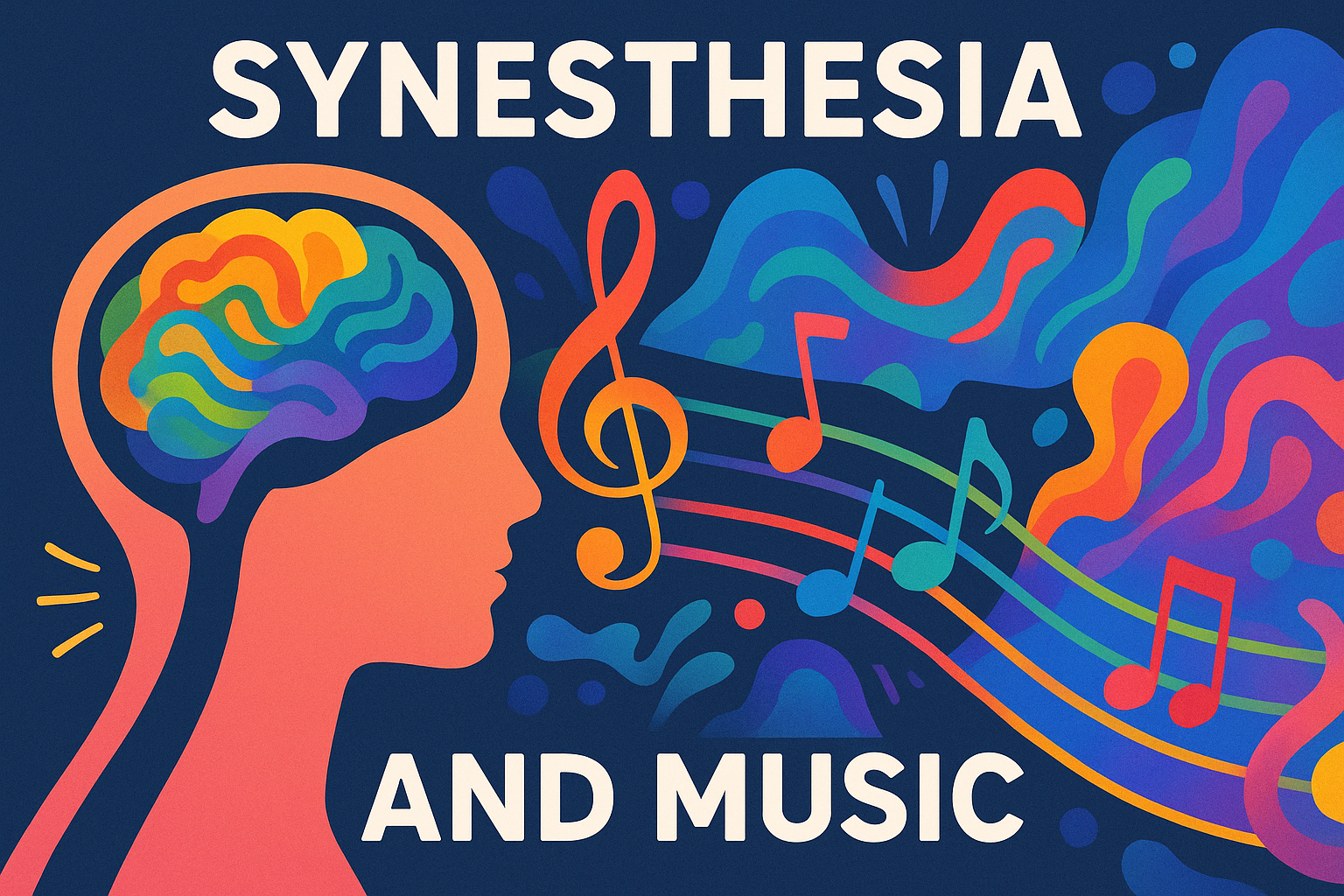
Imagine listening to a song and seeing colors dance in the air, or tasting a melody like a rich, layered dessert. This is the reality for people with synesthesia, a fascinating neurological phenomenon where the stimulation of one sense involuntarily triggers another. In other words, for someone with synesthesia, the world isn’t experienced in separate sensory compartments—it’s a blended, overlapping tapestry of sights, sounds, tastes, and more.

What Is Synesthesia?
Synesthesia comes from the Greek words syn (together) and aisthēsis (sensation). It describes the blending of senses in a way that most people do not experience. There are dozens of types, but some of the most common include:
- Grapheme-color synesthesia: letters and numbers are associated with specific colors.
- Chromesthesia: sounds trigger colors, shapes, or patterns.
- Lexical-gustatory synesthesia: words or sounds evoke tastes.
For musicians and music lovers, chromesthesia is particularly intriguing.
How Synesthesia Develops
Synesthesia is often genetic, running in families, though environmental factors may also play a role. Some researchers believe it develops from increased connectivity between sensory regions in the brain. For example, in chromesthesia, the auditory cortex (responsible for processing sound) may have stronger cross-talk with the visual cortex (responsible for seeing).
Synesthesia usually becomes apparent in childhood. Many synesthetes report that their experiences have remained consistent over their lifetime—C notes are always blue, or a particular guitar riff always produces a specific shape in their mind.
Synesthesia and Music: What It Looks Like
For musical synesthetes, sounds are rarely just sounds—they carry color, shape, texture, or even motion. Here’s how this can manifest:
- Color associations: Every note, chord, or instrument might have a unique hue. A piano chord could burst in soft pinks and blues, while a trumpet might streak gold across the mental canvas.
- Shapes and patterns: Melodies can create swirling shapes or geometric patterns. Fast tempos might appear as jagged, sharp lines, while slow, legato passages form smooth, flowing ribbons.
- Emotional layering: The colors and shapes are often tied to the emotional quality of the music. A joyful major chord might shine brightly, while a melancholy minor progression may appear darker or muted.
- Consistency across pieces: The same notes and chords evoke the same visuals for a synesthete, even in entirely new songs. This consistency can influence how they compose, perform, or interpret music.
Famous musicians like Pharrell Williams, Billy Joel, and Lorde have described experiencing music in this way, and many credit it with inspiring their creative choices.

Why It Matters
Understanding synesthesia gives us a glimpse into the incredible diversity of human perception. For musicians, it offers a unique way to interact with music—not just hearing it but experiencing it as a full sensory event. It can also enhance memory, composition, and emotional connection, transforming music from a passive listening experience into a vivid, multisensory journey.
Experiencing Synesthesia Yourself
Even if you’re not a synesthete, you can experiment with your senses:
- Close your eyes while listening to a favorite song and notice the “colors” or “textures” that emerge in your mind.
- Experiment with visualizing music using digital tools or painting abstract representations of sound.
Though the experience won’t replicate true synesthesia, it can help you appreciate how profoundly interconnected our senses can be—and why music can feel like more than just sound.